
If the fuse on your hose reel keeps blowing, there are just a few different things that could be causing it.
Luckily, tracing figuring out what’s causing it is pretty simple.
Ask yourself the following questions and choose the answer that fits:
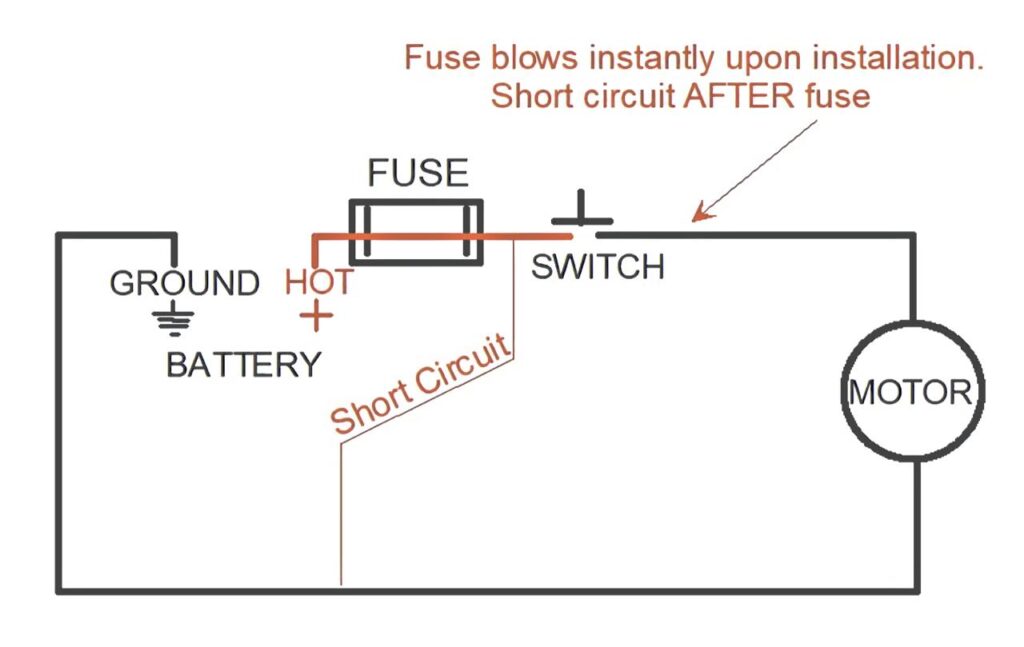
Does it blow as soon as you put it in?
If the answer is “Yes”, then you have a “short circuit” in the wiring somewhere downstream from the fuse, but before the switch.
To remedy this, replace or repair the wiring as necessary. Look for damaged insulation. The location will be somewhere BEFORE
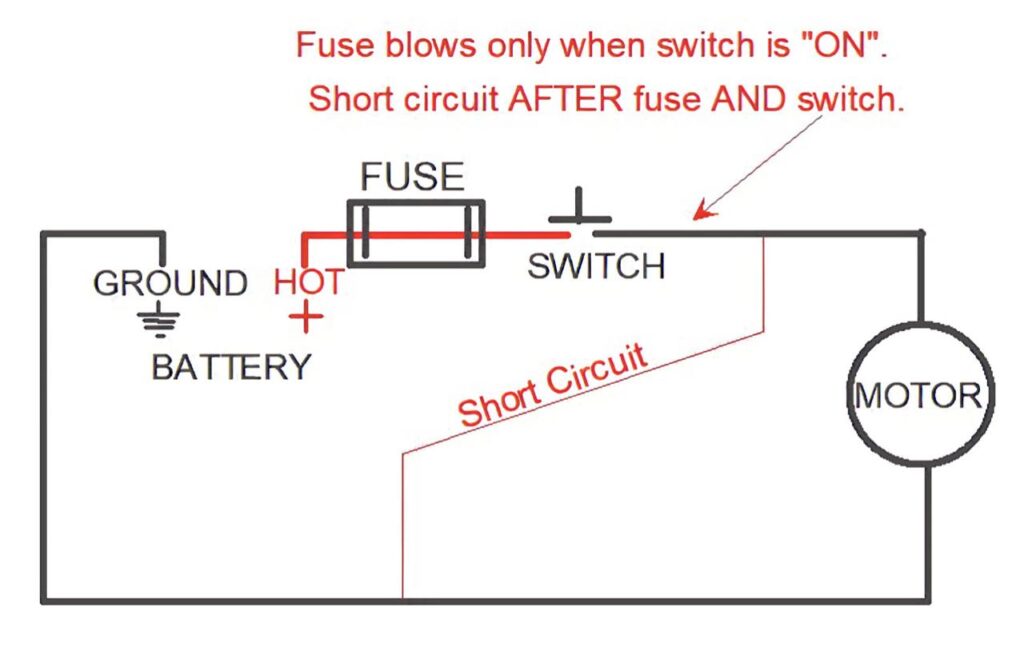
Does it NOT blow when you put it in, but does as soon as you push the switch?
If the answer is “Yes”, then you have a “short circuit” in the wiring somewhere downstream from the fuse. (The switch connects the short to the power source.)
To remedy this, replace or repair the wiring as necessary. Look for damaged insulation. The location will be somewhere AFTER THE SWITCH.
Does it NOT blow when you put it in and does NOT blow as soon as the switch is, “ON”, but blows after a few seconds of operation?
If the answer is “Yes”, then you either:
Have an under- sized fuse.
On most electric rewind vacuum reels, the current drawn is up to 30 AMPS. So, you want a fuse that’s rated for 30 (maybe a bit more), so that it will not blow, when 30 AMPS is drawn.
Depending upon the speed and size of the reel (faster draws more current and larger diameter offers more resistance to the motor, due to the size difference between the motor pulley and the larger reel hoop), the draw could be up to 35 AMPS. So, if a 30 AMP fuse blows while the reel is turning, then a 40 AMP fuse is the best next choice.
Or, the wiring is under- sized, gauge- wise.
Smaller wire gauge offers more resistance to the current running through it. A 10 gauge stranded copper wire does handle 30 AMPS well. (It can actually handle more, assuming that the insulation is good and the operating temperature is not above 15 degrees.) So, if your wiring is smaller than 10 gauge, replace it.
If your wiring from the reel to the power source is 10 gauge and over 8 feet, you may need to go to 8 gauge wire.