
Live swivels for water and pressure hose reels are serious time savers. But live vacuum reel connections are a different story. They reduce vacuum performance – and not just a little bit- which means that they actually slow down production. The culprit is that the coiled hose on the reel, that stays connected while you clean, is killing airflow. Here’s exactly why a live vacuum connection is usually the wrong choice, what it costs in real performance terms, and the narrow situations where it genuinely earns its place.
What Is a “Live Vacuum” Option on a Hose Reel?
A “live vacuum reel” routes the vacuum pathway through the reel itself, so the hose stays connected to the vacuum hose reel, while, at the same time, being connected to a cleaning or extraction tool, during machine operation.
In a standard setup, the vacuum hose connects directly to the machine—no suction runs through the reel mechanism. The live option promises – and delivers – faster setup and fewer manual connections.
Sounds like a good idea, especially since live connections for water and pressure hose reels work so well. But the reality is that, “negative pressure” (vacuum) airflow, has limited force available to overcome restrictions. (It’s very different from the dynamics of pressure pumps and compressed fluid flow, which have more than enough force available to compensate the resistance offered by coils of hose.)
The Core Problem: Coiled Hose Destroys Airflow
A Google search on the subject resulted in the following:
“When air travels through a coiled layout, centrifugal forces create secondary helical flow patterns inside the hose, forcing the air against the outer wall and adding friction.”
It’s a lot like the G- force you experience while driving a car through a turn in the road. The sharper the turn, the more “pull” you feel while in the curve.
In airflow, inside of a hose, the result is, what is known as, “centrifugal force”. And the result is, “turbulence”.
Here is what Wikipedia has to say about it: Turbulence is chaotic, irregular fluid motion characterized by rapid changes in pressure and flow velocity
So, the coils of hose force the airflow to constantly turn, rather than allowing it to go in a straight line. That forcing along a curved pathway, generates friction along the inner wall of the hose and turbulence is the effect.
The result is that moving air through coils requires far more force than moving it through a straight run of the same diameter. And there is the problem with live vacuum on a carpet cleaning hose reel.
That turbulence causes a condition that requires force to overcome it and get the airflow moving – or trying to move – into a straight line again.
Rather than being referred to as “pressure”, vacuum is termed, “negative pressure”. And rather than being measured in pounds per square inch (“PSI”), vacuum is measured in, “lift”- either “water lift” (“H2O), or “Mercury lift” (“ Hg.)
- (“H2O and ”Hg.are similar to vacuum, what Fahrenheit and Centigrade are to temperature measurement- in that they’re two ways of describing one thing. In the case of “H2O and “Hg., vacuum force is what’s being measured and described by the terms. And the basic difference between the two ways of description, is that Mercury weighs more than water, so it requires more force to move the same amount of Mercury a specific distance (height of a column of one of the two liquids), than it does to lift a column of water to the same height.)
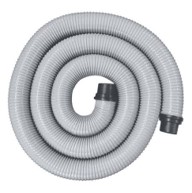
Any time vacuum hose stays coiled anywhere – including loops that are laying on the ground – while the system is running – the internal friction that results from the airflow being forced into a curve, directly interferes with airflow.
And very similar to a car going through a sharp (smaller “radius”, basically, “half- diameter”) curve, The smaller the coil, the more the restriction, due to increased friction, which results in more turbulence, which requires more force (“lift”) to overcome.
- As an example, a coil that has a radius of 24”, has less restriction than a coil with a radius of 18”, and a coil with a 12” radius has more restriction than one with an 18” radius, etc.
Coil radius of hose on a hose reel is smallest at the center of the reel drum or bundle. So, airflow restriction is greatest at the part of the coils that are closest to the center of the reel. And they are the coils that are used less often so, “uncoiled” less often. As a result, more often than not, the part of the hose that interferes the most, is still coiled on the reel.
Click here for a good video on the basics of fluid flow through coils
Here’s a general look at how the numbers work: a straight 2-inch vacuum hose with smooth and clean interior (We’ll get into this in: “Carpet Cleaning Vacuum Performance: The Dirty Secret of Carpet Cleaning Vacuum Performance”) , consumes roughly 2 inches Hg of available lift per 50-foot section. A typical vacuum blower only has about 15 inches Hg of total lift to work with—a fixed ceiling you can’t do much about.
At 200 feet of hose under ideal conditions, you’ve already consumed 8 inches Hg, leaving just 6 to 7” Hg. at the wand to work with. Coiling that hose on a live vacuum reel makes those numbers worse by 39%, assuming that the coil is 24” diameter.
Internal coils on a vacuum hose reel are about 14.25” diameter (7.125” radius), assuming that the cross- tubes that connect the two hoops of the reel are spaced at a 12” diameter. (Cross- tube spacing, plus .25” for hose wall thickness, + 1.25” – for ½ of the diameter of the vacuum hose, x 2 sides of the coil). And the next coil would be about 3” larger (so, have less turbulence), etc.
Why Live Vacuum Is Not Like Live Pressure
Pressure and Vacuum look similar because they are 2 sides of the same flow to and from the job surface. So the performance seems like it “should” be comparable.
The critical difference: The operating pressure of a carpet cleaning truck mount is always less than the pump can deliver (since most pumps used in truck mounts deliver 1,500 PSI or more). As a result, pressure pumps can be dialed up to a higher pressure, in order to overcome resistance from coiled hose.
Rotary lobe vacuum blowers cannot. They have a limited range of available lift, and coiling eats into that range immediately.
The Hidden Cost of Live Vacuum Connection: Slower Jobs
So… The workaround that saves setup / breakdown time for live pressure setups, does exist for live vacuum – but cleaning performance is reduced – because vacuum force is comparatively limited and cannot be increased via turning a regulator knob.
Reduced vacuum efficiency means that the operator will have to clean (or extract) more slowly.
Reduced vacuum doesn’t just mean weaker suction—it means that every job takes longer:
- More passes with the cleaning wand
- Longer dwell time for chemicals to emulsify
- Slower water extraction, because concentrated water (vs. humid air flow) requires more force to be pulled.
These compound across a full workday and steadily erode profitability. So, the real cost is lost productivity – across hundreds of jobs per year.
A live vacuum reel that saves two minutes on setup can easily add ten minutes per job on a relatively – small job – in reduced extraction performance.
That math just doesn’t add up in your favor.
When Live Vacuum Actually Makes Sense
There is actually one scenario where the tradeoff flips: high-volume, short-hose-run work where setup / breakdown speed is the critical variable.
We worked with a contractor who held contracts with retail businesses in a northern downtown. During winter, his jobs often focus upon extracting melted snow at his clients’ business entrances – tracked in by foot traffic. He did multiple stops per day – at each customer location – short hose runs each time. Maybe 3 to 5 minutes total job time, per stop. The airflow penalty was smaller because extraction force of vacuum wasn’t as critical as time on the job. He was simply extracting tracked- in, melted snow. And for his business model, the time savings between stops were real.
If your business model looks like his – decreased vacuum is acceptable, fast cycling, short hose runs, volume-based income—live vacuum might actually deserve a closer look.
The Smarter Workaround
If setup speed is the goal, there’s another way to get it, without sacrificing vacuum performance: Position the vacuum connection at the base of the hose reel, at the door, rather than walking from the reel, to the front of your machine to connect, or routing suction through the reel mechanism.
The hose still stays organized on the reel, but it’s not connected through the reel. The vacuum path from the reel to the machine stays straight and low-resistance. No coil penalty, minimal airflow loss. It solves the convenience problem without sacrificing extraction performance.
We do manufacture live connections for our vacuum reels. They’re listed here:
Click Here
The Bottom Line
Live vacuum costs you airflow and job speed in most setups. For most operators, placing the vacuum connection at the base of the reel is the smarter move—you get organization without the airflow penalty. The only time to seriously consider live vacuum is high-volume, short-run work where cycling speed matters more than peak extraction power.
If you want to match a reel configuration to how your operation actually runs, the full reel package options are a practical place to start.