
In this post, we cover what “ergonomics” actually means in the context of carpet cleaning and hose reels, the most common mistakes and the practical steps you can take—starting today—to protect your body for the long haul.
“Ergonomics” is the study of designing and arranging tools, tasks, and work environments so they fit the people who use them, rather than forcing workers to adapt to poorly designed conditions.
Most carpet care and remediation professionals never think about “ergonomics” – until their shoulder and back starts aching during a workday in which they’ve been winding heavy hoses manually, several of times a day.
That strain builds up over time. It doesn’t show up as an injury right away, but quietly compounds over months and years.
The Occupation of Carpet Care (and Related Activities) is Notorious for Producing Arm, Shoulder and Back Problems
Carpet care work involves using one hand to push and pull a cleaning wand hundreds of times on each job and typically thousands of times in a work day.
It’s not all arm- work. The arm connects through the operator’s shoulder, down their back, through the hips and legs, to the floor. And it’s virtually ALL using the chain of delivery on one side of the body, to do the work.
As a result, that one side of the body gets stronger. But the other side, doesn’t. In fact, it tends to get a bit weaker, as the dominant side “takes over”, not only in work tasks, but in anything else that requires muscular strength. When this happens, you have a “muscle imbalance” and can become injured easily.
That muscle imbalance is the basis for back pain, shoulder, arm and hand pain, because it results in a constant tension held in those areas. And it’s reinforced typically 5 or more days a week.
The subtle thing about imbalances is that they occur slowly, so that you tend to overlook them... until one day when you look in the mirror and notice that you aren't standing straight anymore.
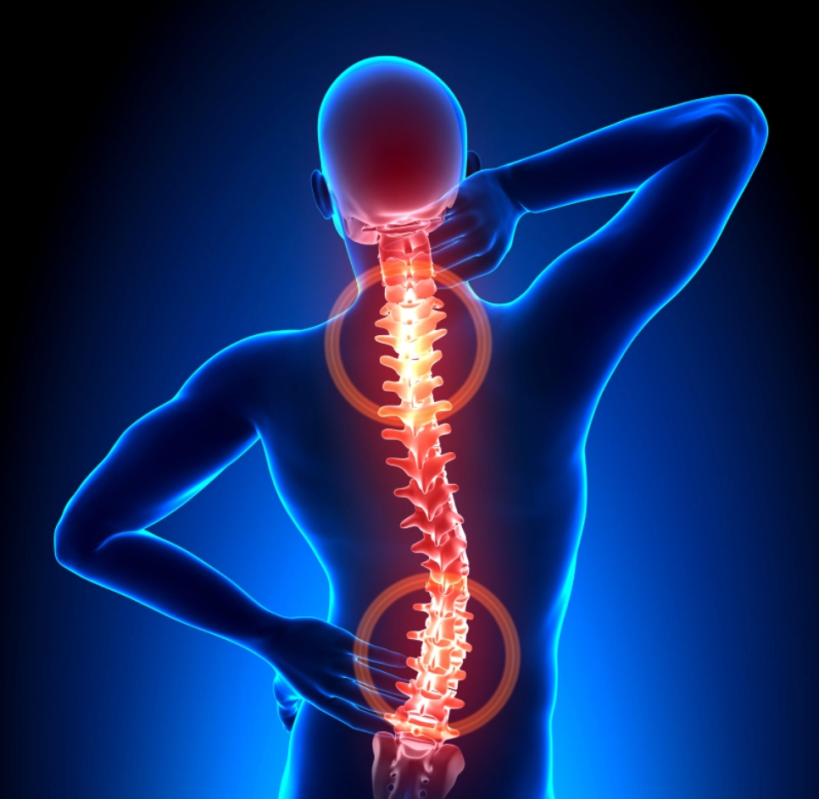
This is the result of a tilted hip and is typically accompanied by an unnaturally- curved spine. The spine is shifted at the hip, but you attempt to remain straight, so your spine shifts to the opposite direction, resulting in a sideways curve (“scoliosis”).
This condition is accompanied by soreness and stiffness, if you work to correct it before it progresses further and can cause compressed vertebrae and herniated discs if you don’t.
Regarding the work of cleaning carpet with a floor wand, do the following:
1.) Use both sides equally when you clean. It works best if you use your weaker side more at first, until you’re comfortable with it.
2.) Be sure to stand as straight as possible. Bending over when you push the wand makes things worse by putting your back muscles in a weak position, and they can strain even more as a result.
3.) Keep the wand grip in front of you as much as possible when you push. If you allow the wand handle to come back past your side, the wand becomes much harder to push, since you are pushing the wand “down” (into the floor) as much as “out” (across the floor).
Basically, keep the wand “trigger hand” in front of you, for the most part. Don’t let it come past the front of your stomach on the back stroke. And give the wand a little, almost unnoticeable upward “tug” with the front hand, as you begin the forward motion of each stroke, in order to make the beginning smoother. (This breaks any vacuum “lock” on the carpet and ensures that you’re not pushing “down”, and into the carpet, vs. pushing “across” it.)
Actually, cleaning with a scrub wand need not be so “unnatural”. Look at it as if it’s a form of exercise, and follow guidelines for good form.
4.) It’s important to use more than just your arm motion to move the wand. Why? Because using your entire body brings larger muscle groups into play, which, in effect, gives you more available strength and leverage, and because doing so “spreads” the work over a larger number of “groups” of muscles, lessening the work any individual sub- muscle group muscle (like your shoulder, for instance…) must do. That gives you more endurance as a side- benefit as well… To do this, rotate your body slightly in the forward and backward motion of each direction of the stroke, and don’t lock your knees! Learn to relax as much as possible, as you push (and pull) the wand.
Ergonomic Habits Most Users Ignore- Until Changing is “Too Awkward” to Do
Here’s the tip that consistently surprises people:
If you’re right-handed, train yourself from day one to guide the wand with your left hand. If you’re left-handed, do the opposite.
The earlier you build this habit, the more natural it becomes—but starting at any point is better than never starting. The first few days will feel awkward. What you’re doing is distributing wear across both sides of the body instead of letting one arm, one shoulder, and one side of your upper back absorb the entire load across a decades-long career. This costs nothing. It just requires deliberate practice early enough to become natural movement.
Pair this with micro-breaks. Brief pauses to stretch your hands, wrists, and shoulders further reduce cumulative load. Thirty seconds of stretching between jobs is maintenance, not a luxury. OSHA recognizes micro-breaks as a legitimate tool for reducing musculoskeletal strain in physically demanding work environments.
These habits cost almost nothing. The alternative costs far more.
Hose Reels - What is Their Purpose and How Does Ergonomics Fit In?
A hose reel does one core job: it organizes, stores, and deploys hose efficiently. Less space required, less tangling, fewer tripping hazards, less time required for hose management and therefore, more time for actual production.
From an ease- of- use standpoint, hose reels can reduce unnecessary strain, awkward postures, and repetitive motions that wear you down over time. It’s not about comfort for its own sake. It’s about protecting your long-term capacity to work.
But in extreme cases- such as a poorly- designed hose reel (making it uncomfortable to grip when it’s spinning and / or difficult to wind), or one that’s in need of repair or replacement, a hose reel can actually become a source of injury rather than a tool that helps to prevents it.
A hose reel designed without ergonomic consideration, can actually become a source of long- term muscle strain, when the winding mechanism demands repeated forceful effort, or, even if it’s electric rewind, controls are located in inconvenient positions, the reel can become a source of ultimate injury, rather than a tool that helps to prevents it.
A hose reel, designed specifically with ease of use in mind does an even better job of reducing repetitive- use muscle strain. And you can feel the difference, from the very first use of it.
The Two Main Categories of Carpet Cleaning Hose Reels
Understanding reel types will help this look at ergonomics and hose reels.
- Manual rewind reels The user cranks a handle, or spins a large vacuum reel by hand, to wind the hose back onto the drum. Manual vacuum reels are the most common, least expensive (because they’re typically included “at no extra charge”, in the purchase of a truck mounted cleaning system), and the highest physical demand option.
- Electric (motorized) rewind reels A motor does the winding entirely. The user guides the hose, but cranking effort is completely eliminated. This is the gold standard for ergonomic performance.
The ease- of- use gap between electric and manual hose reels grows as the length of hose used is increased. An operator using 300, or even 400-foot hoses uses more effort – and for a longer span of time – than one using 200 feet.
And, not surprisingly, terrain also factors in. Not all jobs are across level ground. And any up- and- down route to a job’s front door from the truck results in more effort required to pull hoses back to the work van.
Most Users Don’t Consider This About Manual Hose Reels
The implications with manual winding aren’t any single session—it’s the accumulation of winding a hose manually several times a day loads the hand, arm, shoulder, upper back, and lower back. These are the same muscle groups – typically on the same side of the body – already under load from pushing and pulling cleaning wands on every job.
Repeatedly stressing a muscle group that never fully recovers between sessions leads to cumulative trauma. Workers often don’t connect the dots between daily winding habits and the shoulder injury that could eventually need medical attention, because the link isn’t obvious – until the damage is done.
This pattern plays out in the cleaning and remediation industries on a daily basis. Someone a few years into the work starts noticing chronic shoulder and upper back pain and assumes it’s just part of the job.
It isn’t, “just part of the job”. It’s the predictable (and preventable) result of repeated mechanical stress on the same muscles, day after day, week after week, year after year, without relief.
The real-world consequences -time off work, physical therapy, potential surgery, are not unusual, isolated cases. They’re where cumulative strain reliably leads when underlying habits don’t change.
Every one of those outcomes is preventable with the right equipment choices and the right work habits, made early enough.
What Are the Benefits of an Ergonomic Hose Reel Setup?
An ergonomic setup delivers three concrete benefits:
Reduced daily fatigue. When winding effort is eliminated or minimized, you finish each day with more energy in reserve. That sustained energy translates to better performance across a work day- and across a career.
Lower long-term injury risk. Fewer repetitive strain events accumulating in your body means a lower probability of needing physical therapy or surgery. That’s a practical outcome: more productive years, not fewer.
Better financial outcomes. Fewer injuries mean fewer lost workdays, lower workers’ compensation costs, and better employee retention. The upfront cost of an electric reel is a fraction of the cost of a single surgical procedure, a round of physical therapy, or losing a trained worker to a preventable injury.
Ergonomic choices are an investment in the tool that matters most—the person using the equipment.
Two Overlooked Ergonomic Features in Hose Reel Setup
Two factors consistently rise above the rest—and both are underestimated.
Manual Hose Reels: (Most buyers default to manual because the sticker price is lower. But cost comparisons that stop at purchase price miss the full picture.) Hand comfort is “key”. That’s because if comfort is always the norm, injuries and muscle strain are much less likely.
For vacuum reels: Hoops (the outer circles of tube that form the circles) should be made of tubing that “feels comfortable” in your hand. If it’s comfortable, it’s easy to grip. And if it’s easy to grip, it’s easier to control- especially when you put your hand on it to slow it or to stop it. (By contrast, a small tube diameter can be uncomfortable, difficult to grip when it’s moving and result in an increased potential for injury as a result.)
For supply reels: The same principle applies. Knobs and crank- handles should be “comfort grip”, for the same reasons. But even more so, spinning knobs can be a source of impact to the operator’s hand(s).
Installation Location: Whether it’s manual Vacuum Reels or manual Supply Reels, it’s ultra- important to install them in a location that’s easy to reach, without bending over and without reaching over something else, to get to them.
Electric Rewind Hose Reels: Speaking strictly from the stand point of ergonomics, the physical cost of manual winding—paid out across every workday, every season, every year, adds up. Add the potential financial cost of injury, and the math shifts dramatically in favor of electric. Hand comfort is still a factor (because there may be a time that manual operation is necessary). But for powered reels, switch placement is a factor to consider.
When evaluating an electric reel installation, treat switch placement as seriously as hose capacity or pressure rating. The switch should be reachable from where you naturally stand while guiding the hose, without stretching or stepping out of position..
(There is actually a financial benefit to electric rewind hose reels, as we explain here.)
Control Switch Placement. This is the detail that even people who have already chosen electric rewind reels, often overlook. A poorly- positioned switch forces the operator to reach, twist, or step out of position to activate the motor- adding a new, specific kind of potential strain as a result (or, being layered on top of pre- existing muscle strain and fatigue).
Before committing to a configuration, hands-free and conveniently placed switches are worth understanding in detail.
Ergonomics and hose reels only work together when both the power source and the controls are thoughtfully positioned.
Start Protecting Your Body Before the Pain Starts
The best time to address ergonomics is before the shoulder starts aching—not after. Every day of repetitive manual winding without attention to comfort, becomes a reinforced, difficult to change habit. And it’s a small withdrawal from a physical account that doesn’t replenish as quickly as it depletes.
If you’re evaluating a move to electric rewind, the electric rewind supply reels available today are worth a close look—prioritize switch placement and hose capacity as your primary selection criteria.
The habits and equipment choices you make now are the ones your body will thank you for—or hold against you—years from now.