
Live Vacuum (Yes, We Do Offer It) : The Design Matters
The design of a live vacuum hose connection used in carpet cleaning and other industries, should aim to reduce internal turbulence- not to accept it. In this blog entry, we highlight why – especially since live vacuum connections do cause vacuum loss – the design of a live vacuum reel’s connection is ultra- important- and what to look for when buying a vacuum hose reel with a live connection.
Drawbacks of a Typical Live Vacuum Connection
Manufacturers who focus upon convenience of construction and keeping manufacturing costs as low as possible, continue that philosophy through most- if not all – of their products. From what we’ve seen, live connections for vacuum reels are not an exception to that philosophy.
Most live vacuum connections feature a 90- degree turn, with a small radius (“half- diameter”) of about 3”. And the smaller the radius of the turn, the more turbulence it causes, as the airflow is forced into an increasingly compact area to make that turn, for smaller- radius turns.
That approach to design and manufacturing tends to focus upon using “off the shelf”, pre- made parts that are “functional”, rather than parts that are chosen, designed, or manufactured for, “performance”.
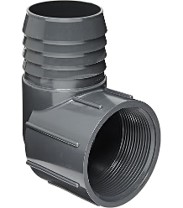
In live connections for vacuum reels, this approach ignores two important things in particular:
- Any reduction in airway diameter, results in a reduction of vacuum efficiency
- The smaller the radius of a turn in airway plumbing, the more the interference that turn adds
Building a live connection that ignores these two isn’t about performance. It’s about production cost.
It also ignores the following:
- A 2” circle’s total square inches (as stated above), is 3.14”
- A 1.75” circle’s total square inch area is 2.41”
- So about 23% less airflow potential for a 1.75” vs. 2.0”
How does the above relate to live vacuum connections?
Most live vacuum connections feature a reduction in airway diameter.
Most live vacuum connections use “off- the- shelf” parts, which have thicker wall- thicknesses and use standard pipe sizes to connect to.
2” O.D. round tube with a 3/16” wall has an I.D. of 1.625
A 2” hose connection for a live vacuum reel, that has standard schedule 40 pipe as the axle of rotation, has an internal diameter of just over 2”, but an O.D. of 2.375”, which is too large for a 2” hose to connect to.
So typically, the pipe used for live vacuum reel connections is either:
- 5” (which has an I.D. of 1.5” and O.D. of 1.9”)
Or
- 2” tube, with a wall thickness of about 1/8”, which has an I.D. of 1.75”
Both of the above choices severely interfere with airflow, because the internal diameter is smaller than 2”, which requires additional force to move the airflow through.
But airflow at a given pressure (or, “negative pressure”, in the case of vacuum) isn’t about diameter and bend radius alone. Other factors, such as interior wall smoothness and even the angle of the edge of pipe or tube, where connections are made, is a factor, because these two can add to more turbulence.
And as we detailed in, Live Vacuum Reels Part 1: Pro and Con turbulence requires force (consumes available “lift”) to overcome it. And “lift” is limited.
The design of a live vacuum hose connection should aim to reduce internal turbulence- not to accept it.
That means that they should not narrow the interior diameter of the airway and should make the radius of the turn, inside the live connection- as gradual as reasonably possible.
It also means that airways should be as smooth as possible. Because even a small amount of roughness of the interior wall, will increase friction between the air and the surface.
How a Live Vacuum Connection Should be Designed
If having a live vacuum genuinely fits your operation, then certain construction specifics will make a substantial performance difference. Look for three things, specifically:
- Thin-wall steel tubing
(To maximize internal airway diameter)
- Swept turns, rather than sharp 90-degree elbows
(To minimize internal turbulence)
- Stainless- steel construction
(To allow thin- wall without loss of strength and to provide a corrosion- free, long life)
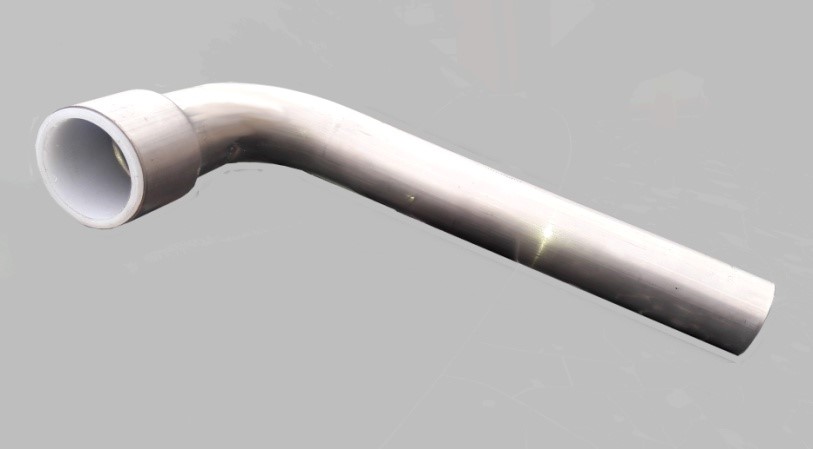
This is the way we manufacture them.
And here is how they look on a completed vacuum hose reel.
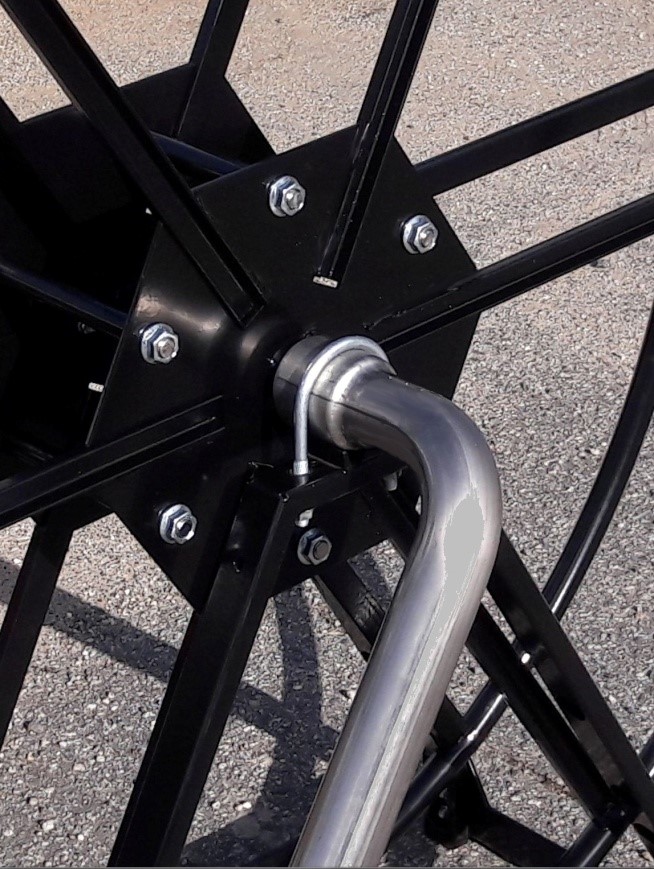
The right construction offsets much of the potential loss of performance. Browse this option if you’re considering a live vacuum reel connection.